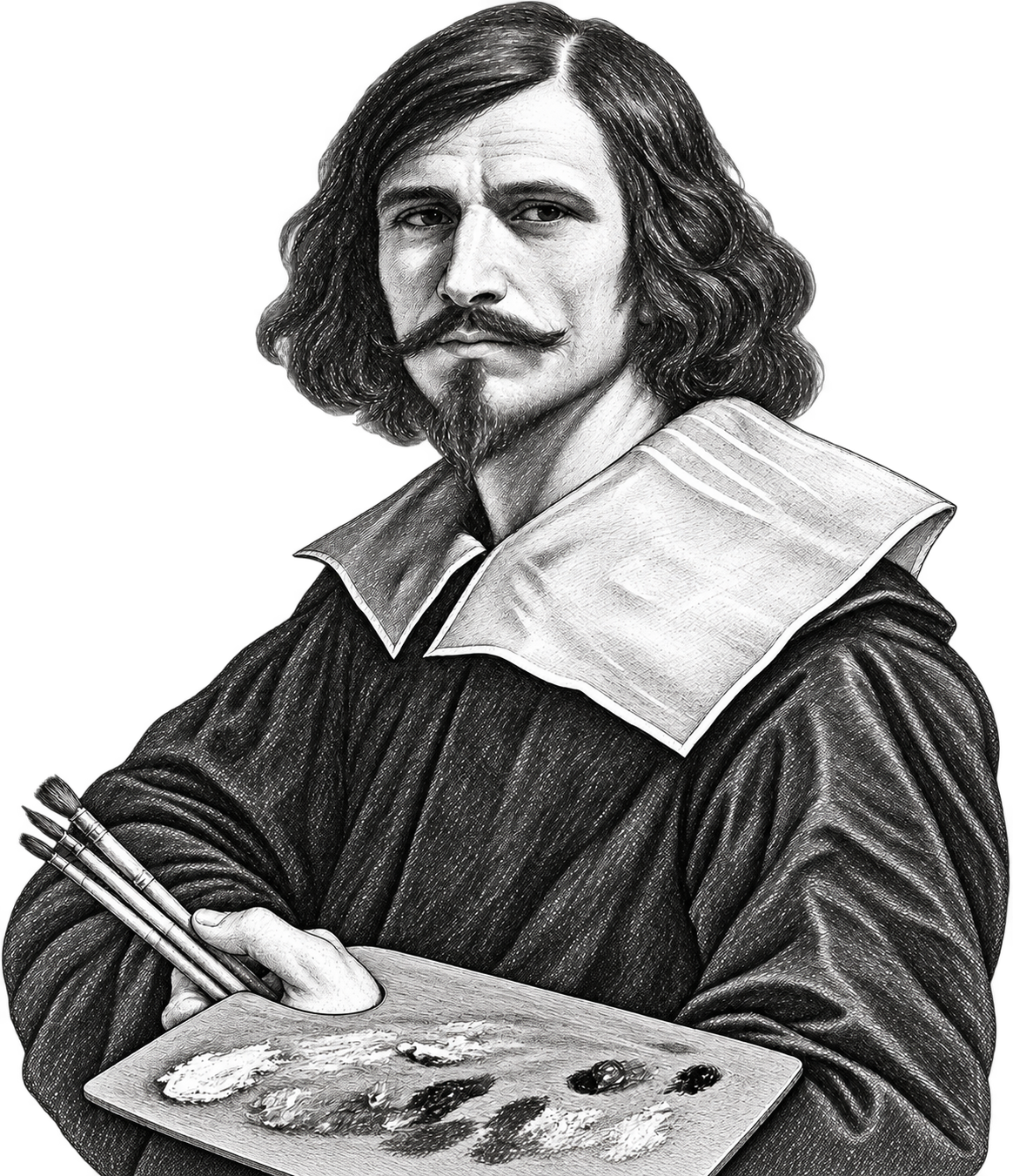
AI-assisted artist illustration created for The Baroque Art Bible. This is an artistic interpretation and not an authenticated historical portrait.
Giovanni Francesco Barbieri, called Guercino
1591–1666
Giovanni Francesco Barbieri, universally known as Guercino, was one of the most inventive painters and draftsmen of the Italian Baroque. His nickname means “the Squinter” and refers to a childhood eye condition. Celebrated for dramatic light, energetic compositions, and acute psychological observation, he built an international reputation while remaining closely associated with his native town of Cento and, later, Bologna.
Guercino developed his early style in Emilia rather than Rome. The Carracci and other northern Italian painters helped shape his vigorous brushwork, rugged naturalism, and strong contrasts of light and shadow. His figures communicate through urgent gestures and vividly observed expressions, turning sacred history into immediate human drama. He was also an exceptional draftsman whose searching studies reveal how he tested compositions, poses, and the fall of light from many angles.
Early public works in Cento and Bologna brought Guercino influential patrons, including Cardinal Jacopo Serra. In 1621 Pope Gregory XV called him to Rome, where he painted major works for the Ludovisi family and the altarpiece The Burial of Saint Petronilla for Saint Peter's. After the pope's death in 1623, Guercino returned to Cento. He moved to Bologna in 1642 after the death of Guido Reni, becoming the city's leading painter.
Biblical narratives remained central throughout his career. Among his best-known treatments are Elijah Fed by Ravens, The Incredulity of Saint Thomas, Jacob Blessing the Sons of Joseph, Samson Captured by the Philistines, and The Presentation of Jesus in the Temple. His early paintings favour bold chiaroscuro and emotional immediacy; his later work adopts a lighter palette, greater narrative clarity, and the refined classicism admired in Bologna.
This section of Art Bible introduces Guercino's biblical art through the stories, patrons, and visual decisions behind it. The collection now opens with four of his masterpieces: The Return of the Prodigal Son, The Raising of Lazarus, The Incredulity of Saint Thomas, and Christ and the Woman of Samaria. Each page pairs the painting with its scriptural and historical context, and the complete collection and its biblical stories connect these works with the passages that inspired them, showing how his command of light, movement, and human feeling made him a defining voice of seventeenth-century Italian painting.


