Stories
Stories illuminated
Each chapter pairs a biblical passage with a masterwork, then reveals the painting's symbolism, composition, historical setting and emotional power.

Matthew 9:9–13Interactive close reading
The Calling
Caravaggio freezes the instant between a command and an obedience. The beam of light — the only thing in the picture that moves — carries the call across the room to a man who still seems mid-thought, one hand on the coins. Grace arrives not in a temple but in a tax office, and the light makes no distinction between the sacred and the everyday.

Acts 9:1–19Interactive close reading
Transformation in a flash of light
Conversion here is not a slow growth but a fall — Saul thrown from his horse, arms flung wide, blind beneath a light the onlookers do not share. Caravaggio collapses the entire Damascus road into a single dark frame: the animal dominates, the man is helpless, and the whole picture pivots on the moment the persecutor becomes the apostle.

John 18:1–11Interactive close reading
Betrayal compressed into one encounter
The betrayal is compressed into a single unforgettable encounter: Judas has already kissed, and Jesus has already surrendered. Caravaggio catches the aftermath — the torchbearer's head thrown back, the armour shining, the disciples scattering — while Christ, calm and lit from within, meets the crowd with his answer. Evil is present, but so is a peace that does not flinch.

Luke 23:26–49Interactive close reading
Sacrifice and redemption
The Passion is work — a cross hauled upright by straining bodies, a dead Christ lowered by careful hands, a body held in perfect stillness against the sky. Rubens turns sacrifice into muscular theatre; Rembrandt turns it into tenderness; Velázquez reduces it to a single figure hanging alone in grey light. Each painter asks the same question differently: what does it mean to give everything?

Luke 24:13–35Interactive close reading
The moment of recognition
At the table in Emmaus, ordinary gestures become a revelation. The bread is broken, the hand is raised, and in that split second the stranger is recognised. Caravaggio's still life spills off the table and the disciples' arms fly outward — recognition arrives through bread, gesture and silence, not through proof.

Luke 15:11–32Interactive close reading
Return and restoration
Rembrandt's late masterpiece slows the parable to a single embrace. The father's hands — one aged, one young — rest on the ragged back of the returning son; the light falls on the reconciliation and on nothing else. Compassion, not judgement, is the centre of the picture, and forgiveness becomes visible as warm, enveloping light.
Judith 13Interactive close reading
Courage and deliverance
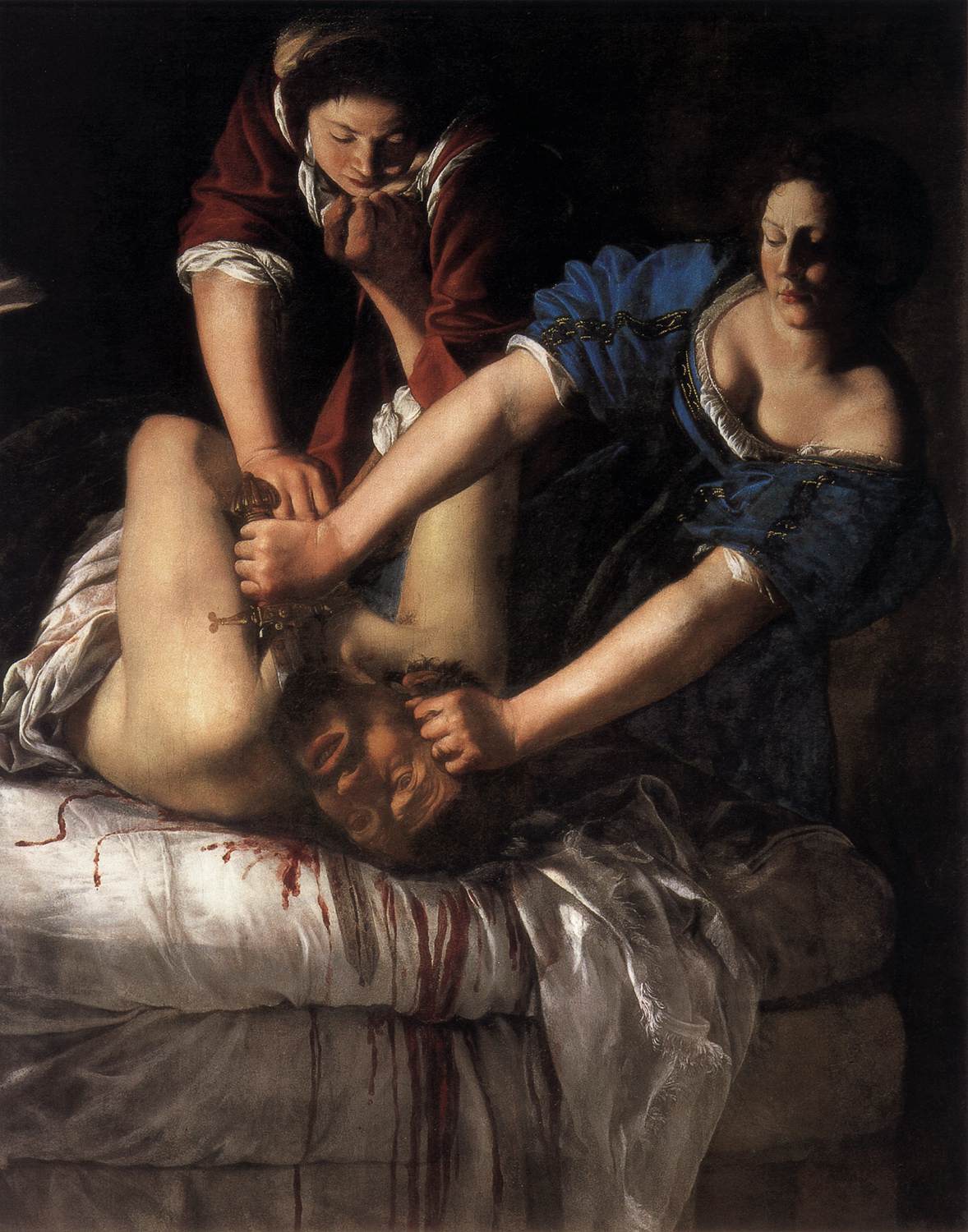
Judith is deliverance rendered with uncompromising realism. Caravaggio shows the act itself, blood and struggle; Artemisia gives it even greater physical force — forearms braced, sheets soaked, the heroine wholly in control. In their hands the biblical heroine is not an allegory but a woman of nerve, and courage has a body.

Luke 10:38–42Interactive close reading
One thing is needful
Velázquez sets the story in a kitchen where a woman grinds garlic at a table spread with fish and eggs, while a girl looks out at us and gestures toward a scene in the upper corner: Christ with Mary seated at his feet. Martha serves; Mary listens. The contrast is not between work and idleness but between distraction and attention — the one thing that will not be taken away.

Matthew 2:1–12Interactive close reading
Gifts for a newborn king
Velázquez treats the Adoration not as a royal pageant but as a quiet human encounter. The figures fill the picture plane with little room to spare: Mary holds the child, Joseph stands nearby, and the oldest of the Magi kneels closest of all. Faces, hands, and the folds of cloth carry the story — worldly rank bows before an infant whose importance is shown only by the attention of those around him.

Luke 15:11–32Interactive close reading
Forgiveness becomes visible
Guercino skips the spectacular reunion and concentrates on the quieter moment that follows: the returned son being dressed and restored to his place in the household. Repentance becomes vulnerability, forgiveness becomes touch, and restoration becomes clothing — the drama lies not in the journey but in forgiveness becoming physically visible.

John 11:1–44Interactive close reading
The moment between death and life
Guercino paints resurrection as a process rather than a finished event: a heavy, pale body still wrapped in burial cloths begins to respond while Christ commands from the shadows. Death is made physically credible through pallor, weight, and darkness, so the miracle becomes visible through bodies and the astonishment of the witnesses — the impossible rendered with the ordinary materials of painting.

John 20:24–29Interactive close reading
Seeing begins to become belief
Guercino turns a theological argument about resurrection into a physical investigation. Christ exposes the wound in his side; Thomas leans in to examine it. The resurrected body carries the marks of death, and the viewer is drawn so close to the evidence that seeing begins to become belief.

John 4:1–42Interactive close reading
From water to understanding
Guercino paints recognition rather than resurrection. There is no physical miracle — only two people in conversation, hands gesturing between them beside a well. Differences of gender, community, and tradition are present, yet the central action is dialogue: the gradual process by which one person begins to see another differently.
Luke 8:1–3; Luke 24:1–10; John 19:25; John 20:1–18
Alone with time
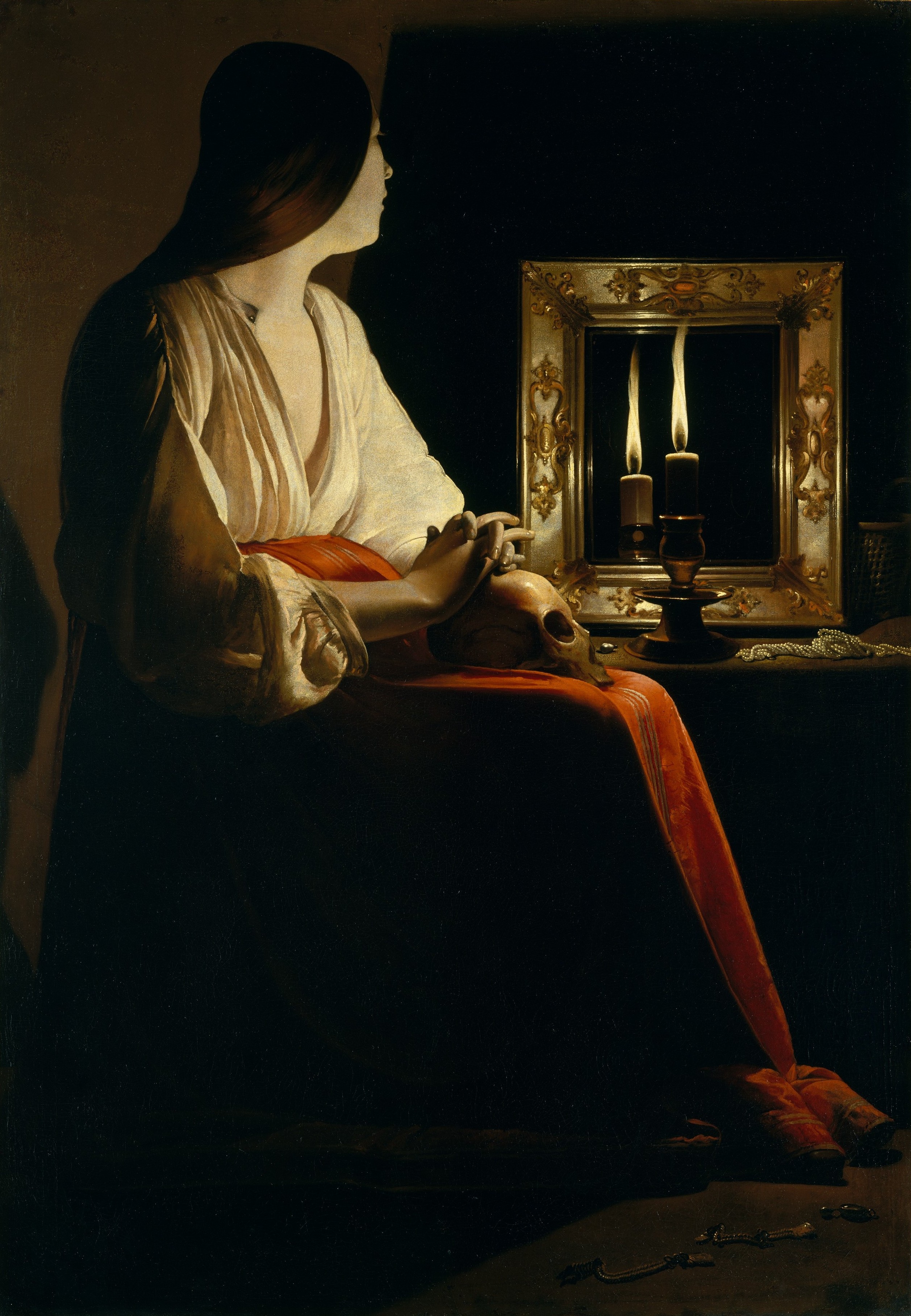
La Tour does not illustrate a Gospel event. He paints what repentance might look like: a woman alone in candlelight, a skull in her lap, a mirror that reflects what beauty cannot escape. There is almost no action — only stillness, duration, and the knowledge that to burn is to disappear.

Matthew 13:55; Mark 6:3
The wood remembers the future
There is no miracle and no public event — only a father working and a child holding the light. Yet La Tour loads the ordinary workshop with foresight: the wood will become the cross, and the child who illuminates the work is the one who will suffer on it. Labor, childhood, and the future Crucifixion share one candle flame.

Luke 2:1–20; Matthew 1:18–25
A child has entered the world
No angels, shepherds, or supernatural light — just a hidden candle, a wrapped child, and the quiet attention of two women. La Tour subtracts the spectacle of the Nativity until only the human core remains: a newborn held in the dark, where birth already touches the cloth that will one day wrap the Crucifixion.